Rodent exclusion addresses structural vulnerability across older Jefferson County properties. In historic masonry and wood-frame homes throughout Forest Park, Highland Park, and Glen Iris, aging mortar joints, soffit…
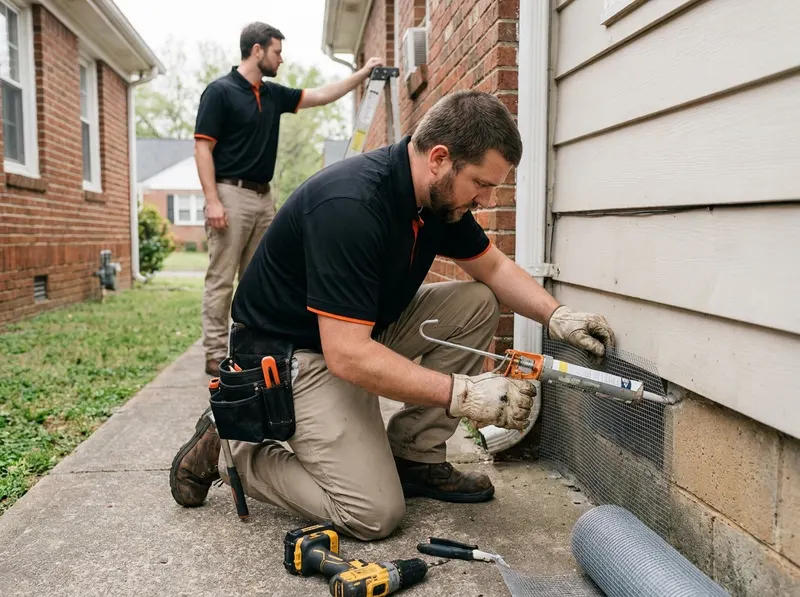
Rodent exclusion addresses structural vulnerability across older Jefferson County properties. In historic masonry and wood-frame homes throughout Forest Park, Highland Park, and Glen Iris, aging mortar joints, soffit junctions, and decorative crawlspace vents present accessible pathways for Norway rats, roof rats, and house mice. Rodents exploit foundation penetrations as narrow as 0.25 inches. Traditional baiting addresses existing indoor populations but fails to resolve exterior vulnerability, allowing successive populations to re-enter living quarters. Exclusion replaces toxic chemical cycles by establishing an impenetrable mechanical boundary across the foundation sill, roofline returns, and utility chase lines.
Properties in Avondale, Crestwood North, and Crestline Park often feature mature tree canopies directly overhanging shingle lines, creating elevated transit lanes for roof rats. Exclusion measures across these structures prioritize upper-level architectural intersections, including ridge vents, gable louvers, and chimney counter-flashing. In lower-elevation properties near East Lake and Roebuck Springs, moisture-heavy crawlspaces demand heavy-gauge barrier mesh across foundation vents to preserve interior airflow while halting subterranean entry. Establishing durable steel barriers prevents recurring structural damage, chewed electrical wiring, and insulation contamination without distributing poisons near household pets or garden beds.
The implementation follows a rigorous physical sequence. Technicians map every gap exceeding one-quarter inch across the foundation, siding transitions, and roof envelope. Durable 16-gauge galvanized mesh is mechanically fastened over air intake vents, while plumbing line openings receive escutcheon plates backfilled with copper mesh and industrial-grade polyurethanes. The trade-off between exterior mechanical exclusion and continuous interior trapping is direct: exclusion requires higher upfront physical labor to reinforce structural weaknesses, eliminating the ongoing maintenance overhead and decomposition odors associated with interior chemical bait stations.
Every job gets a firm, written price after a free on-site visit.
Tell us about your rodent exclusion and proofing job in Birmingham and we'll send a clear, written quote, usually the same day.
 Kelvoro Pest Barrier