Subfloor relative humidity in Jefferson County frequently exceeds 70 percent due to Birmingham's humid subtropical climate and heavy summer rainfall patterns. In historic homes across Highland Park, Forest Park, and…
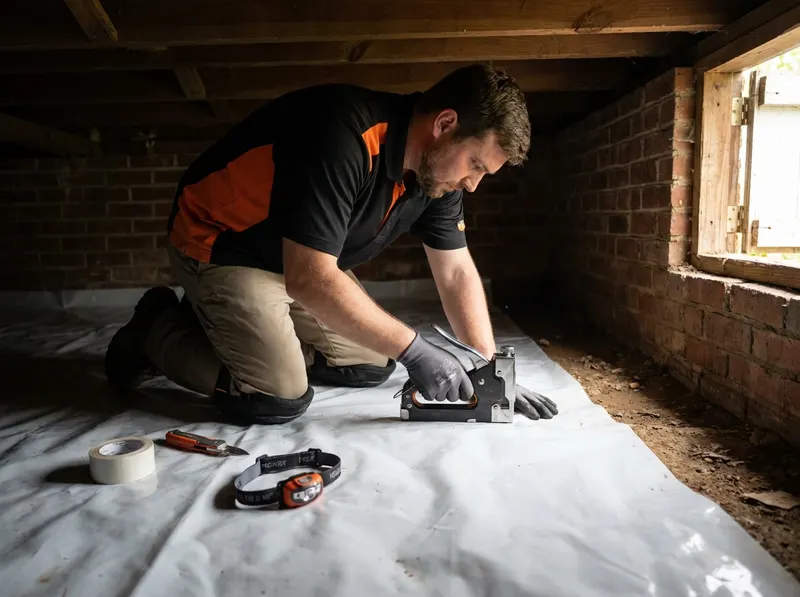
Subfloor relative humidity in Jefferson County frequently exceeds 70 percent due to Birmingham's humid subtropical climate and heavy summer rainfall patterns. In historic homes across Highland Park, Forest Park, and Glen Iris, vented foundations actively draw in warm, humid outdoor air. When this moist air meets cooler ductwork beneath floor joists, condensation forms on the subfloor structure. This persistent dampness softens native southern yellow pine framing, accelerating structural degradation and attracting subterranean termites, wood-boring beetles, and American cockroaches. Crawl space encapsulation and moisture defense solves this issue by mechanically isolating the foundation from ground evaporation and exterior ambient humidity.
Selecting sealed encapsulation over standard open-vent moisture treatments depends on crawl space soil composition and seasonal elevation changes. In low-lying, clay-dense parcels near East Lake, Roebuck Springs, and Smithfield, a simple gravel trench or standalone fan fails because the red Alabama clay retains capillary groundwater that continuously evaporates into the floor framing. Encapsulation fits properties requiring permanent subfloor stabilization, running heavy 12 to 20 mil barriers across dirt surfaces and up masonry piers to create a contiguous moisture seal. The trade-off is mechanical dependency: an encapsulated crawl space requires a dedicated, continuous-draining dehumidifier with an automated humidistat to maintain relative air humidity between 45 and 55 percent, consuming modest continuous household electricity while permanently protecting upper living areas from damp odors and pest migration.
In sloping hillside districts such as Five Points South, Crestline Park, and Crestwood North, encapsulation functions as an exterior pest exclusion perimeter. Open foundation vents invite field rodents and wood-destroying organisms directly into building cavities. Encapsulation seals these exterior vent openings with custom-fitted closed-cell foam and metal mesh covers, shifting moisture management entirely indoors. Technicians maintain a distinct 3-inch inspection gap along the top edge of foundation masonry walls, satisfying Alabama state termite code and structural inspection requirements by ensuring continuous visual monitoring for termite shelter tubes. Contact (659) 272-4127 to establish a scheduled on-site inspection for crawl space evaluation.
Every job gets a firm, written price after a free on-site visit.
Tell us about your crawl space encapsulation and moisture defense job in Birmingham and we'll send a clear, written quote, usually the same day.
 Kelvoro Pest Barrier